Gas Line Installation
Gas Line Rough-In for New Construction: A Builder's Guide for Tampa Bay Homes
October 12, 2026By Gas Pros Inc. · FL LP Gas License No. 33846
Mastering gas line rough-in planning ensures smooth inspections and flawless appliance performance in Tampa Bay new builds. Learn essential rough-in heights for ranges and dryers, CSST versus black iron selection, trade coordination strategies, and Hillsborough County inspection requirements to keep your job sites on schedule.
<p><strong>Direct Answer:</strong> Performing a proper gas line rough-in during new residential construction requires calculating total connected BTU load prior to framing, selecting code-compliant pipe materials like CSST or black iron, placing stubs at exact trade-standard heights, and protecting wall penetrations with recessed gas rough-in boxes. In Hillsborough County, seamless trade coordination between gas contractors, plumbers, electricians, and framers prevents scheduling delays and ensures first-pass approval during City of Tampa or county rough-in inspections. For expert builder-focused gas rough-in planning and installation, contact <a href="https://gasprosinc.com">Gas Pros Inc</a> at (813) 425-3565.</p>
<h2>1. Calculating Total Connected BTU Load Before Framing Begins</h2>
<p>In modern Tampa Bay residential construction, fuel gas systems powering multiple high-draw appliances demand precise load sizing before studs are raised. Custom and production home plans frequently feature 48-inch commercial-style ranges (up to 100,000 BTU/hr), high-capacity tankless water heaters (199,000 BTU/hr), gas clothes dryers (20,000 to 30,000 BTU/hr), outdoor kitchen grills with side burners (80,000+ BTU/hr), and standby generators (200,000+ BTU/hr). Sizing main trunks and branch lines requires calculating total system demand using the Florida Building Code – Fuel Gas pipe sizing charts.</p>
<p>Undersized piping creates pressure drops across the manifold. When a homeowner runs the tankless water heater, range burners, and pool heater simultaneously, undersized lines starve appliances of adequate gas pressure, leading to ignition errors, flame flickering, or lockouts. Providing an accurate appliance schedule to your gas contractor during pre-construction ensures proper main trunk diameter—typically 1-inch to 1-1/4-inch for high-load custom homes—and establishes clean branch routing through the structure.</p>
<h2>2. Establishing the Correct Gas Line Rough In Height for Stove and Range Installs</h2>
<p>One of the most frequent framing-stage errors on residential job sites involves improper stub-out location for kitchen cooktops and slide-in ranges. Determining the correct <strong>gas line rough in height for stove</strong> and range units depends directly on cabinet layout, range model specifications, and backsplash design. For standard 30-inch and 36-inch freestanding or slide-in gas ranges, the trade-standard <strong>gas line rough in for range</strong> stub-out height sits between 6 and 12 inches above the finished floor, centered within a specific 6-inch wide recessed cavity behind the appliance location.</p>
<p>Placing the stub-out higher than 12 inches off the finished floor causes the shut-off valve and flexible connector to strike the lower rear wall of the range cabinet, preventing the appliance from sliding flush against the back wall. For island cooktops, the gas line extends through the subfloor into the cabinet base cavity with an accessible shut-off valve installed per code. Standardizing stub-out height checks during framing eliminates expensive drywall patching and cabinet modifications during final mechanical trim.</p>
<h2>3. Laundry Room Planning: Dryer Gas Line Rough In Requirements</h2>
<p>Planning the <strong>dryer gas line rough in</strong> requires close coordination between gas piping mechanics, framers, and HVAC duct installers. A standard residential gas dryer requires a 1/2-inch gas supply branch delivering 20,000 to 30,000 BTU/hr. The recommended rough-in stub height for a gas dryer is 36 to 48 inches above the finished subfloor, positioned adjacent to the laundry receptacle box and out of the path of the 4-inch metal dryer exhaust duct.</p>
<p>Elevating the dryer gas stub above the 36-inch line allows trim technicians to easily reach the manual shut-off valve after the appliance is slid into position, satisfying Florida Building Code accessibility rules. Positioning the gas line too close to the laundry box or dryer vent penetration creates tight clearance issues that can pinch flexible connectors. Marking exact dryer dimensions on the laundry room framing wall during rough mechanicals ensures all trades maintain required clearances before drywall installation.</p>
<h2>4. Recessed Protection: Installing a Gas Line Rough In Box</h2>
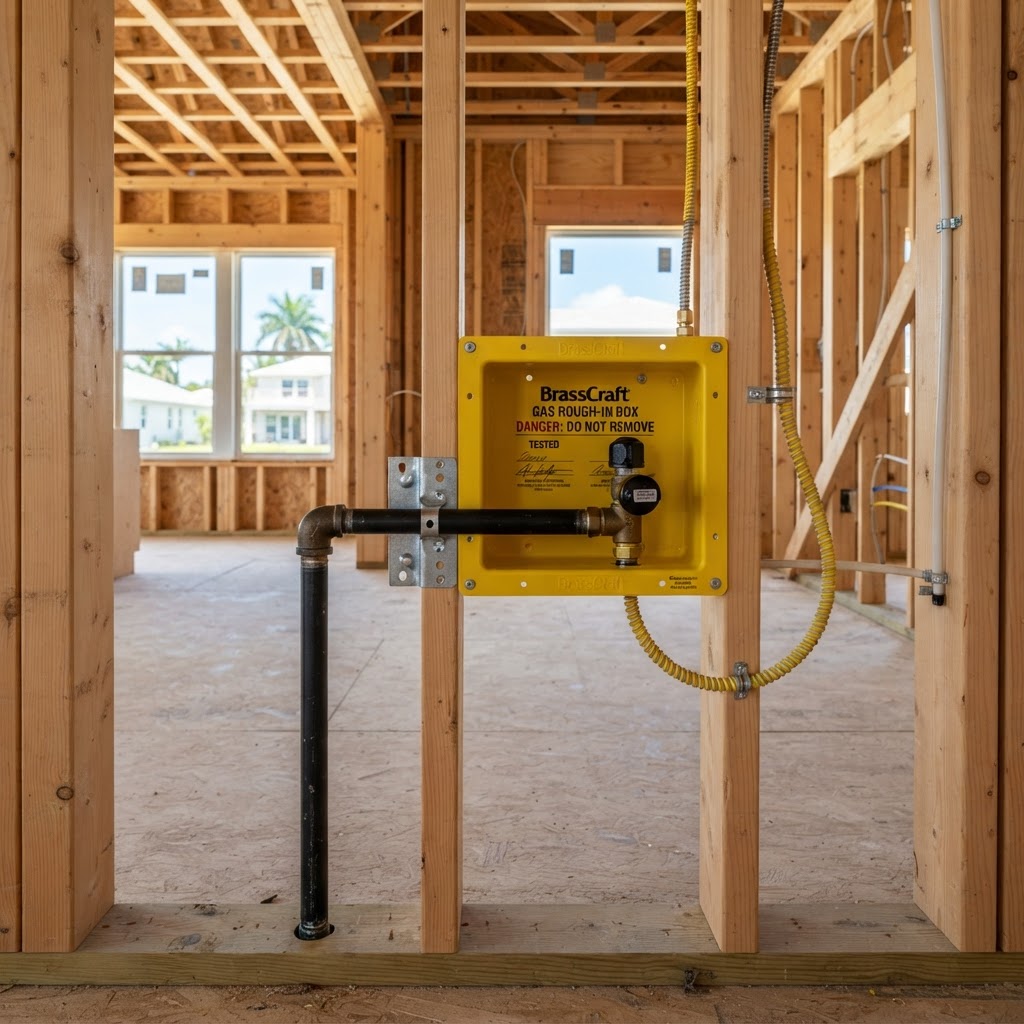
<p>Modern luxury homes in Riverview, Apollo Beach, and Tampa increasingly utilize a recessed <strong>gas line rough in box</strong> for kitchen ranges, laundry dryers, and wall-mounted gas fireplaces. A recessed gas rough-in box mounts directly between 16-inch center wall studs during framing, housing both the supply stub-out and an integrated manual shut-off valve inside a fire-rated protective plastic or steel enclosure.</p>
<p>Installing a dedicated rough-in box keeps the shut-off valve flush inside the wall cavity, allowing ranges and dryers to sit completely flush against adjacent cabinetry and baseboards. Furthermore, heavy-duty steel mounting brackets and protective nail plates guard gas piping against accidental drywall screw or finish nail penetrations during finish phases.</p>
<h2>5. CSST vs. Black Iron: Material Selection for Modern Florida Home Construction</h2>
<p>Selecting between Corrugated Stainless Steel Tubing (CSST) and traditional Schedule 40 black iron pipe impacts labor efficiency, routing flexibility, and job site material budgets. While black iron pipe remains the standard for exposed utility runs, CSST is preferred for interior rough-in work through complex framing in Hillsborough County builds.</p>
<table style="width: 100%; border-collapse: collapse; margin: 20px 0; font-size: 14px; text-align: left;">
<thead>
<tr style="background-color: #1b365d; color: #ffffff;">
<th style="padding: 10px; border: 1px solid #cccccc;">Specification / Metric</th>
<th style="padding: 10px; border: 1px solid #cccccc;">Corrugated Stainless Steel Tubing (CSST)</th>
<th style="padding: 10px; border: 1px solid #cccccc;">Schedule 40 Black Iron Pipe</th>
</tr>
</thead>
<tbody>
<tr>
<td style="padding: 10px; border: 1px solid #cccccc; font-weight: bold;">Installation Speed</td>
<td style="padding: 10px; border: 1px solid #cccccc;">High (continuous flexible runs, fewer fittings)</td>
<td style="padding: 10px; border: 1px solid #cccccc;">Moderate (requires threading, cutting, & elbows)</td>
</tr>
<tr style="background-color: #f9f9f9;">
<td style="padding: 10px; border: 1px solid #cccccc; font-weight: bold;">Labor Cost Impact</td>
<td style="padding: 10px; border: 1px solid #cccccc;">Reduces rough-in labor by up to 40-50%</td>
<td style="padding: 10px; border: 1px solid #cccccc;">Higher labor hours due to custom fitting assembly</td>
</tr>
<tr>
<td style="padding: 10px; border: 1px solid #cccccc; font-weight: bold;">Standard Rough-In Heights</td>
<td style="padding: 10px; border: 1px solid #cccccc;">Range: 6"-12" AFF | Dryer: 36"-48" AFF</td>
<td style="padding: 10px; border: 1px solid #cccccc;">Range: 6"-12" AFF | Dryer: 36"-48" AFF</td>
</tr>
<tr style="background-color: #f9f9f9;">
<td style="padding: 10px; border: 1px solid #cccccc; font-weight: bold;">Bonding Code Requirement</td>
<td style="padding: 10px; border: 1px solid #cccccc;">Requires manufacturer-approved bonding clamp & wire</td>
<td style="padding: 10px; border: 1px solid #cccccc;">Standard grounding protocols per NEC / FBC</td>
</tr>
</tbody>
</table>
<h2>6. Cross-Trade Coordination and Inspection Sequencing in Hillsborough County</h2>
<p>Passing gas rough-in inspections with City of Tampa Development Services or Hillsborough County Development Services requires structured trade sequencing. Gas piping rough-in must be completed after structural framing and roof dry-in, but prior to insulation, drywall, or slab topping pours.</p>
<p>A successful rough-in inspection workflow includes performing a pre-rough walkthrough with trades, pressuring the line to 10-15 PSI monitored by a calibrated gauge for at least 15 minutes, installing 1/16-inch steel nail striker plates where pipe passes near stud edges, and receiving green tag rough approval prior to insulation.</p>
<h2>Frequently Asked Questions</h2>
<h3>What is the typical rough-in height for a residential gas range?</h3>
<p>The standard gas line rough-in height for a freestanding or slide-in stove is 6 to 12 inches above the finished floor, centered within a 6-inch recessed channel behind the range. This height ensures the manual shut-off valve fits flush inside the rear cabinet cavity without pushing the range out from the wall.</p>
<h3>Is CSST piping allowed in Hillsborough County new home construction?</h3>
<p>Yes, CSST (Corrugated Stainless Steel Tubing) is approved under Florida Building Code – Fuel Gas when installed by a licensed gas contractor. CSST requires proper electrical bonding with a minimum 6 AWG copper wire to mitigate lightning-induced surge risks.</p>
<h3>When should the gas line rough-in inspection occur during home construction?</h3>
<p>Gas line rough-in inspections occur after framing, plumbing top-out, and electrical rough-in, but before insulation and drywall installation. The system must hold static test pressure under inspector observation before drywall approval is granted.</p>
<h2>Partner with Gas Pros Inc on Your Next Hillsborough County Build</h2>
<p>Gas Pros Inc is Hillsborough County’s trusted licensed gas specialty contractor, providing comprehensive fuel gas design, CSST and black pipe rough-in, appliance hookups, and inspection management for custom and production builders. Whether you are building luxury residences in Tampa and Apollo Beach or master-planned communities in Riverview, Wimauma, and Sun City Center, our field crews deliver rapid turnarounds and first-time inspection passes. Contact our commercial builder team today at (813) 425-3565 or visit <a href="https://gasprosinc.com">Gas Pros Inc</a> to submit your plans for bid.</p>