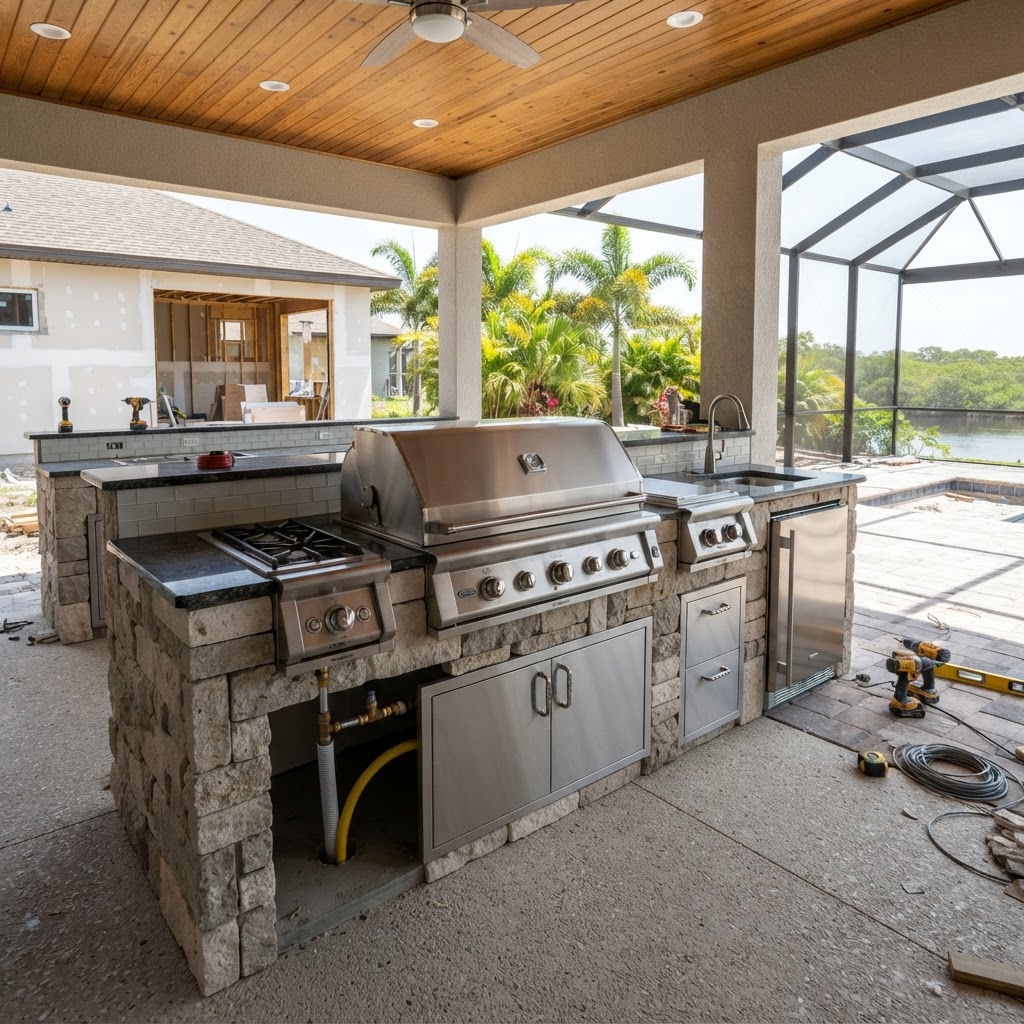
Gas Line Installation
Outdoor Kitchen Gas Lines for New Construction: Builder Planning Guide
October 12, 2026By Gas Pros Inc. · FL LP Gas License No. 33846
Outdoor living spaces drive home sales in Tampa Bay. Master outdoor kitchen gas line planning for new builds, including combined BTU load sizing, buried polyethylene pipe with 14-gauge tracer wire, slab penetration protection, and inspection sequencing in Hillsborough County residential construction.
<p><strong>Direct Answer:</strong> Master-planning outdoor kitchen gas lines during initial slab and framing stages requires calculating cumulative appliance BTU loads, installing Florida code-compliant underground polyethylene (PE) piping with 14-gauge tracer wire, protecting slab penetrations with protective PVC sleeves, and securing pre-pour inspection approvals from Hillsborough County. Incorporating outdoor gas stubs before concrete installation eliminates expensive slab coring and delivers high-margin outdoor living options for Tampa Bay home buyers. For expert builder-focused outdoor gas line planning, contact <a href="https://gasprosinc.com">Gas Pros Inc</a> at (813) 425-3565.</p>
<h2>1. Calculating Combined BTU Loads for Outdoor Cooking Centers</h2>
<p>Modern outdoor living designs in Tampa, Apollo Beach, and Riverview extend beyond simple freestanding grills. Today's outdoor kitchens feature built-in 42-inch stainless steel gas grills (60,000 to 100,000 BTU/hr), power sear burners (24,000 BTU/hr), dual side burners (30,000 BTU/hr), outdoor pizza ovens (40,000 BTU/hr), and linear fire tables (65,000 BTU/hr). Combined outdoor demand can easily top 150,000 to 200,000 BTU/hr.</p>
<p>Sizing outdoor supply branches demands calculating distance runs from the main meter manifold to the patio island. Long underground runs exceeding 40 feet require 3/4-inch or 1-inch pipe diameters to prevent pressure drops. Undersized outdoor piping results in weak grill burner flames when multiple appliances operate simultaneously, leading to negative buyer reviews and warranty calls.</p>
<h2>2. Outdoor Kitchen Gas Equipment Specification & Sizing Table</h2>
<p>Providing clear equipment load data ensures your mechanical subs size yard piping accurately.</p>
<table style="width: 100%; border-collapse: collapse; margin: 20px 0; font-size: 14px; text-align: left;">
<thead>
<tr style="background-color: #1b365d; color: #ffffff;">
<th style="padding: 10px; border: 1px solid #cccccc;">Outdoor Appliance Type</th>
<th style="padding: 10px; border: 1px solid #cccccc;">Average BTU Demand Range</th>
<th style="padding: 10px; border: 1px solid #cccccc;">Recommended Stub Pipe Size</th>
<th style="padding: 10px; border: 1px solid #cccccc;">Underground Burial & Code Requirements</th>
</tr>
</thead>
<tbody>
<tr>
<td style="padding: 10px; border: 1px solid #cccccc; font-weight: bold;">Built-in 36"-42" Gas Grill</td>
<td style="padding: 10px; border: 1px solid #cccccc;">60,000 – 100,000 BTU/hr</td>
<td style="padding: 10px; border: 1px solid #cccccc;">1/2-inch to 3/4-inch Stub</td>
<td style="padding: 10px; border: 1px solid #cccccc;">Min. 18" PE pipe burial depth + riser sleeve</td>
</tr>
<tr style="background-color: #f9f9f9;">
<td style="padding: 10px; border: 1px solid #cccccc; font-weight: bold;">Dual Side Burner / Sear Station</td>
<td style="padding: 10px; border: 1px solid #cccccc;">24,000 – 45,000 BTU/hr</td>
<td style="padding: 10px; border: 1px solid #cccccc;">1/2-inch Branch Stub</td>
<td style="padding: 10px; border: 1px solid #cccccc;">Connected to island internal distribution manifold</td>
</tr>
<tr>
<td style="padding: 10px; border: 1px solid #cccccc; font-weight: bold;">Patio Fire Table / Pit</td>
<td style="padding: 10px; border: 1px solid #cccccc;">50,000 – 90,000 BTU/hr</td>
<td style="padding: 10px; border: 1px solid #cccccc;">3/4-inch Branch Stub</td>
<td style="padding: 10px; border: 1px solid #cccccc;">Keyed shut-off valve within 6 feet of pit edge</td>
</tr>
<tr style="background-color: #f9f9f9;">
<td style="padding: 10px; border: 1px solid #cccccc; font-weight: bold;">Complete Kitchen Island Suite</td>
<td style="padding: 10px; border: 1px solid #cccccc;">130,000 – 220,000 BTU/hr</td>
<td style="padding: 10px; border: 1px solid #cccccc;">3/4-inch to 1-inch Main Supply</td>
<td style="padding: 10px; border: 1px solid #cccccc;">Dedicated manifold with accessible master shut-off</td>
</tr>
</tbody>
</table>
<h2>3. Underground Polyethylene Pipe & 14-Gauge Tracer Wire Requirements</h2>
<p>Under the Florida Building Code – Fuel Gas, metallic piping (such as black iron) buried underground without extensive anti-corrosion wrapping is strictly prohibited due to aggressive Florida soil oxidation. Underground gas lines must utilize yellow medium-density polyethylene (PE) gas pipe specifically manufactured for fuel gas burial.</p>
<p>Florida code mandates two critical underground installation practices:</p>
<ul>
<li><strong>Minimum Burial Depth:</strong> Underground PE gas piping must maintain a minimum burial depth of 18 inches below finished grade (or 12 inches if protected under a 4-inch reinforced concrete slab).</li>
<li><strong>14-Gauge Solid Copper Tracer Wire:</strong> Yellow PE pipe is non-metallic and cannot be located with standard magnetic pipe locators. Installers must lay a continuous 14-gauge insulated yellow copper tracer wire alongside the pipe, terminating above ground at both risers to facilitate future utility locating.</li>
</ul>
<h2>4. Protecting Slab Penetrations and Riser Transitions</h2>
<p>Transitioning from underground PE pipe to above-ground island stub-outs requires approved anodeless risers. Anodeless risers feature a factory-sealed transition from plastic PE pipe to a rigid Schedule 40 steel riser casing, eliminating below-ground mechanical joints.</p>
<p>Where gas risers pass through concrete lanai footings or poured pool decks, mechanics must install protective PVC sleeve conduits around the riser. Sleeving prevents direct contact between wet concrete and metal pipe casings, shielding the pipe from chemical corrosion and accommodating subtle structural settling without putting stress on gas fittings.</p>
<h2>5. Inspection Sequencing Before Concrete Slab Pours</h2>
<p>Proper inspection timing prevents costly delays during patio and lanai construction. Gas Pros Inc follows a strict four-step inspection workflow for outdoor gas lines in Hillsborough County and City of Tampa jurisdictions:</p>
<ol>
<li><strong>Trenching & Pipe Placement:</strong> Excavate trenches to code depth and lay PE pipe with tracer wire on a smooth, rock-free sand bed.</li>
<li><strong>Pressure Test Setup:</strong> Pressurize the underground assembly to 10-15 PSI with air or nitrogen, installing a test gauge for inspector verification.</li>
<li><strong>Pre-Pour Sign-Off:</strong> Obtain green tag underground gas approval from Hillsborough County Development Services before concrete trucks arrive on site.</li>
<li><strong>Final Trim Connection:</strong> Return after island masonry finishes are complete to connect appliances, perform leak detection tests, and verify flame adjustments.</li>
</ol>
<h2>6. Fuel Options for Master-Planned Communities: TECO vs LP Tank Sets</h2>
<p>In master-planned communities across Tampa, outdoor gas kitchens tie into TECO natural gas mains. In outlying suburban locations like Wimauma, Sun City Center, and Lithia, outdoor kitchens rely on dedicated LP propane tank sets.</p>
<p>Gas Pros Inc assists builders in selecting appropriate appliance orifice sizes and setting underground LP tanks that comply with setback clearances from pool decks and property lines. Turnkey gas management ensures every outdoor kitchen operates safely and reliably from day one.</p>
<h2>Frequently Asked Questions</h2>
<h3>What type of pipe is required for underground gas lines in Florida?</h3>
<p>Florida Building Code requires yellow medium-density polyethylene (PE) pipe for underground fuel gas burial. Black iron pipe is prohibited underground unless wrapped with approved anti-corrosion tape, and PE pipe must always transition above ground using anodeless risers.</p>
<h3>Why is tracer wire required on underground gas lines?</h3>
<p>Because polyethylene pipe is non-metallic, utility locators cannot detect it underground. Laying a 14-gauge insulated copper tracer wire along the pipe allows technicians to locate the gas line before future landscape digging or pool excavation.</p>
<h3>What is the minimum depth for burying an outdoor kitchen gas line?</h3>
<p>Underground PE gas pipe must be buried at least 18 inches deep in soil, or 12 inches deep if covered by a minimum 4-inch reinforced concrete slab. Anodeless risers must be used where the pipe emerges above grade.</p>
<h2>Partner with Gas Pros Inc on Your Next Hillsborough County Build</h2>
<p>Deliver turnkey outdoor living spaces to your home buyers with outdoor kitchen gas line planning from Gas Pros Inc. Based in Wimauma and serving Tampa, Riverview, Apollo Beach, Sun City Center, and surrounding areas, our licensed gas contractors deliver rapid, code-compliant outdoor gas installations. Call our builder team today at (813) 425-3565 or visit <a href="https://gasprosinc.com">Gas Pros Inc</a> to submit your outdoor kitchen plans for bid.</p>