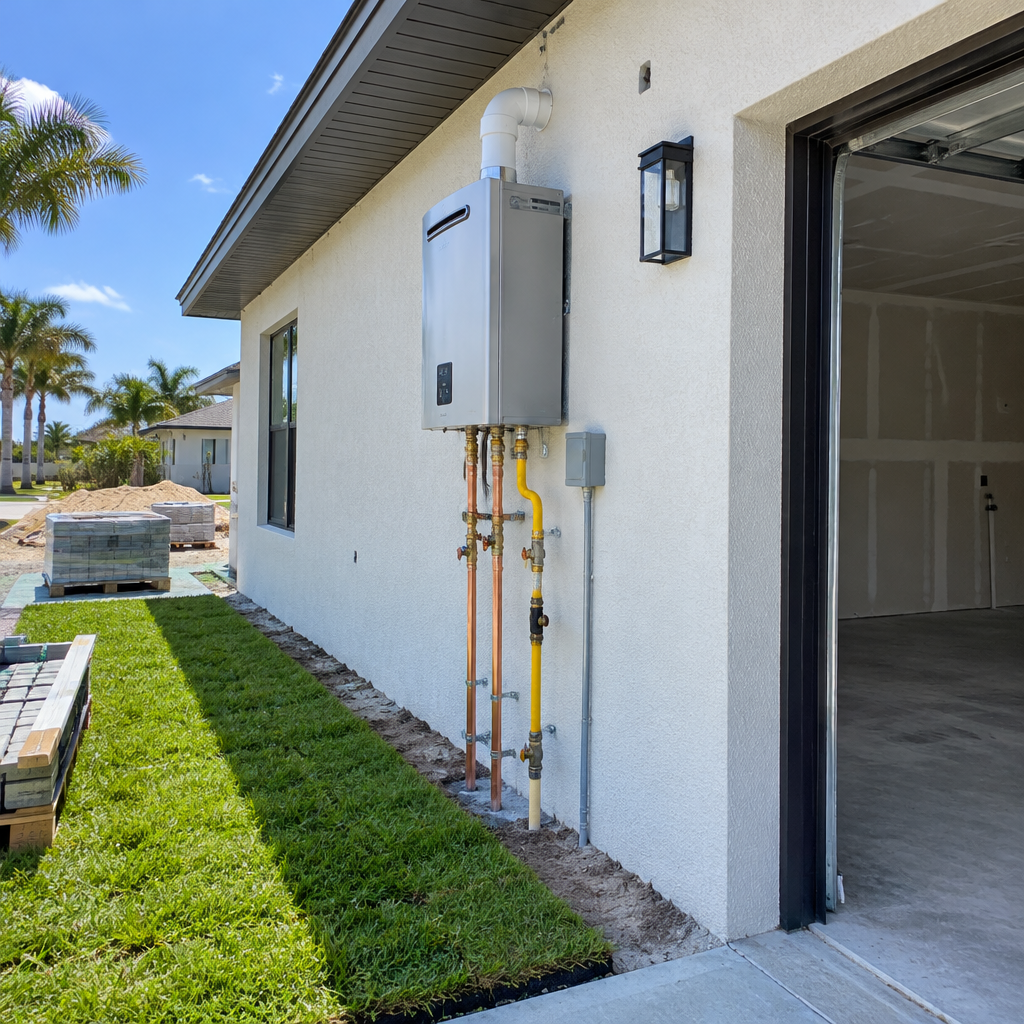
Gas Line Installation
Tankless Water Heater Gas Lines in New Builds: Sizing Basics for Builders
November 2, 2026By Gas Pros Inc. · FL LP Gas License No. 33846
How to size tankless water heater gas lines on a Hillsborough County new build: the real BTU load, developed length, and the test that has to happen before drywall.
<p><strong>Direct Answer:</strong> Sizing a tankless water heater gas line in a new Hillsborough County build starts on the plans, not in the trench. Take the BTU input on the specified model, add it to every other gas appliance on the lot, and size the pipe against the Florida Building Code fuel gas tables using the longest developed length from the meter to the farthest outlet. Get the test and inspection done before drywall, and the tankless unit never becomes the reason a build in Riverview, Apollo Beach, or Wimauma slips a week.</p>
<h2>Start With the Model, Not the Marketing Name</h2>
<p>Tankless units are sold by flow rate and sized by BTU input. A whole-home unit large enough for two showers and a dishwasher can draw close to 199,000 BTU at full fire, which is more than every other gas appliance in a typical production home combined. Confirm the model on the contract matches the model in the mechanical plan before the rough-in is scheduled. On production lots the same model repeats, so the first lot sets the number and every lot after it should match. When the model changes mid-community, the pipe sizing changes with it.</p>
<h2>Build the Total Connected Load</h2>
<p>Add the tankless input to the range, dryer, furnace, fireplace, pool heater, outdoor kitchen, and generator shown on the plans. The sum is the number the pipe has to carry, and it is the number most often understated. A common failure is a gas rough sized for the appliances in the base plan while the option package adds a pool heater and an outdoor kitchen nobody re-checked. On a production build that mistake repeats across the whole phase.</p>
<p>Two scheduling notes that save trips:</p>
<ul><li>Get the final option list from the sales office before the rough, not after.</li><li>If the buyer can still add gas options, size one pipe step up and note it on the plan.</li></ul>
<h2>Size Against Developed Length</h2>
<p>Developed length is the distance the gas actually travels, including the equivalent length of every elbow, tee, and valve, measured from the meter or second-stage regulator to the farthest outlet. On a wide lot in Lithia or a long side-yard run in Riverview, developed length is often twice the straight-line distance on the site plan, and that is what pushes a run from 3/4-inch to 1-inch. Use the capacity tables for the pressure the system will actually operate at, not the highest pressure the table allows.</p>
<h2>Decide the Material and the Route Early</h2>
<p>Black iron, corrugated stainless steel tubing, and polyethylene for underground all size differently and have different support, bonding, and protection requirements. The choice belongs in the plan review, because it changes the stub locations, the support layout, and whether the underground run needs tracer wire and sleeving before the deck pours. Underground polyethylene to a pool heater or an outdoor kitchen must be in place before the deck, and on slab lots the stub from the meter has to be set before the pour.</p>
<h2>Pressure Test Before Drywall, Every Time</h2>
<p>The rough has to hold its test at the pressure and duration the inspector specifies, with the gauge left where it can be read. Schedule the test after the plumbing and HVAC roughs and before insulation, and photograph the gauge with the test log. When the test fails on a production lot it usually fails for one of three reasons: a fitting that was never tightened, a length that was underestimated, or a change order that added load after sizing. All three are cheaper to fix before insulation than after.</p>
<h2>Coordinate Venting, Condensate, and Combustion Air</h2>
<p>A tankless unit needs its vent termination, its condensate drain, and its combustion air resolved at framing. Condensate is acidic and has to drain to an approved point, and neutralization may be required. Vent terminations have clearance requirements to windows, doors, and intakes, and the location that looks convenient on a wall is often the one that fails inspection. Settle this while the framer is still on site, and the mechanical, plumbing, and gas trades stop fighting over the same wall cavity.</p>
<h2>What Actually Fails Inspection</h2>
<ul><li>Load understated because the tankless input was left out of the total</li><li>Developed length measured as straight-line distance</li><li>Missing support on horizontal runs</li><li>Unlisted or unprotected material passing through a wall or slab</li><li>Test not held long enough, or no gauge left for the inspector</li><li>Termination clearances ignored</li></ul>
<p>Every one of those is caught on a pre-drywall walk if someone is looking for it. A ten-minute walk before the insulation crew arrives is cheaper than a stop-work notice.</p>
<h2>FAQ</h2>
<h3>Who can install propane lines in Florida?</h3>
<p>Propane work falls under Chapter 527, Florida Statutes, and requires an FDACS LP-gas licensed contractor. The sizing method is the same as natural gas, but the tables change because the gas has a different specific gravity and the system runs on regulated pressure at the appliance.</p>
<h3>Can the gas line share a trench with the water service?</h3>
<p>That detail gets settled with the Hillsborough County building department before backfill, and it depends on the material, the separation, and the protection used. Get the answer in writing from the inspector rather than assuming the last job's detail applies.</p>
<h3>What happens if the tankless unit is added after the rough is inspected?</h3>
<p>The line gets re-sized and re-tested, and that usually means opening finished surfaces. Confirm the water heating spec before the rough, not after.</p>
<h3>How much lead time does the gas contractor need?</h3>
<p>Enough to measure developed length and order material. Two weeks before the scheduled rough keeps the slab or deck date intact.</p>
<h2>Get Gas Lines on the Trade List</h2>
<p>Gas Pros Inc plans and installs gas lines for custom and production builders across Hillsborough County, from Riverview and Apollo Beach to Lithia, Wimauma, and Sun City Center. We handle natural gas and propane systems, FDACS-licensed LP work, and county inspections, and we combine fireplace, generator, outdoor kitchen, and water heater roughs into one mobilization. Send your plans for bid at <a href="https://gasprosinc.com">gasprosinc.com</a> or call our builder team at <strong>(813) 425-3565</strong>.</p>