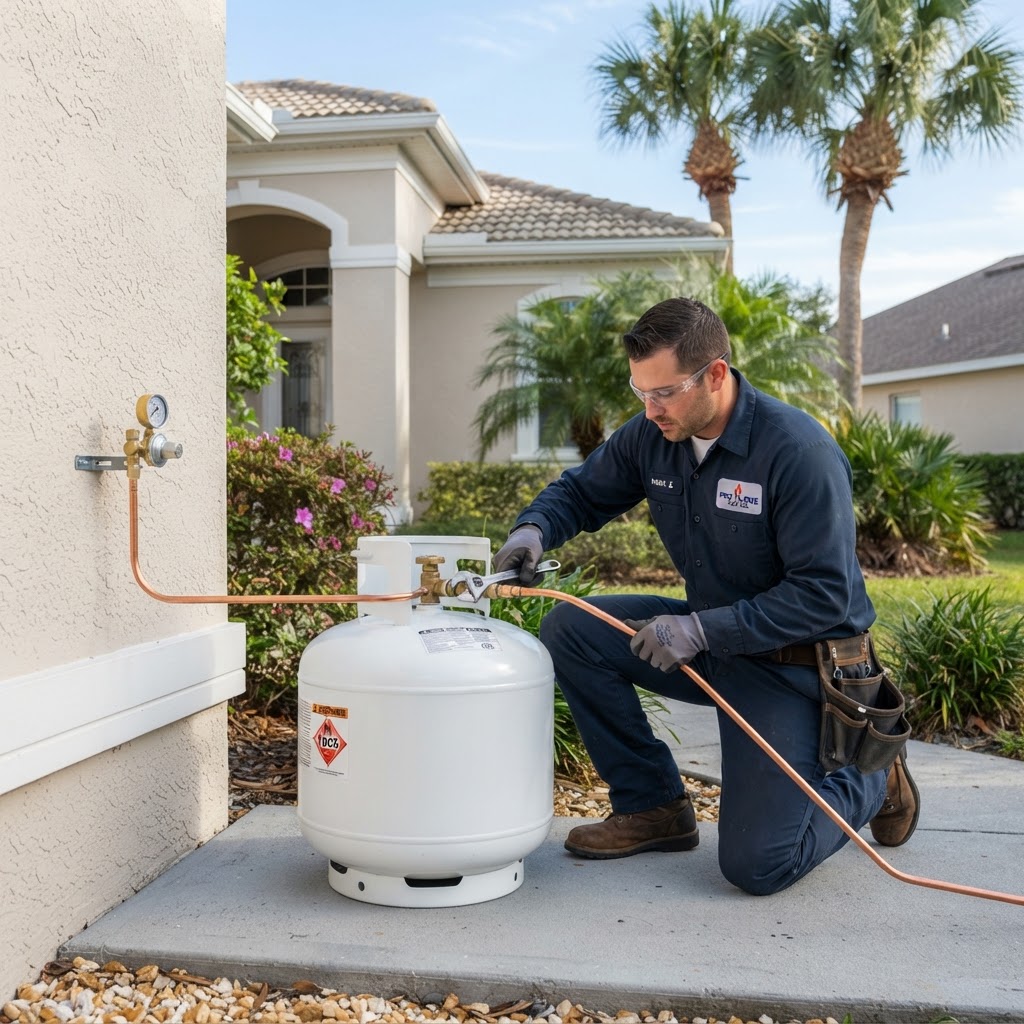
Propane gas line installation in Tampa FL requires a licensed LP gas contractor, a city or county permit, NFPA 58 tank setbacks, and a documented pressure test. Gas Pros Inc installs propane lines and tank sets for generators, pool heaters, and outdoor kitchens across Hillsborough County.
<p><strong>Direct Answer:</strong> Propane gas line installation in Tampa, FL requires a state-licensed LP gas contractor, a permit from the City of Tampa or Hillsborough County, a tank placed to NFPA 58 setback distances, correctly sized two-stage regulation, and a documented pressure test before any appliance is connected. <a href="https://gasprosinc.com">Gas Pros Inc</a> is a Tampa-based licensed gas specialty contractor that installs propane lines and tank sets for generators, pool heaters, outdoor kitchens, and tankless water heaters across Hillsborough County.</p>
<h2>Why So Many Tampa-Area Homes Run on Propane</h2>
<p>Large parts of the greater Tampa area sit beyond the reach of TECO's natural gas mains — particularly Wimauma, Ruskin, Sun City Center, Balm, and pockets of Lithia and Riverview. When municipal gas isn't available, propane is the practical alternative: it runs the same equipment (standby generators, pool heaters, ranges, tankless water heaters, outdoor kitchens) from a tank on your own property, refilled by delivery truck.</p>
<p>The trade-off is that propane is a different engineering job than natural gas. Propane operates at different pressures (11 inches water column at the appliance after regulation), the tank itself has code-required setback distances, and every line has to be sized against the total BTU load of the appliances it feeds. That's why Florida requires a licensed LP gas contractor for the work — not a handyman, and not a general plumber without the LP endorsement.</p>
<h2>How Propane Line Installation Actually Works</h2>
<p><strong>Tank placement and setbacks.</strong> Per NFPA 58, an above-ground propane tank between 125 and 500 gallons must sit at least 10 feet from your home, any property line, and openings like windows and doors. Underground tanks can be placed closer in many jurisdictions, but the excavation, cathodic protection, and backfill add cost. Your propane supplier often handles the tank itself; the contractor runs the piping, regulators, and appliance connections.</p>
<p><strong>Two-stage regulation.</strong> A first-stage regulator at the tank drops tank pressure down to roughly 10 PSI, and a second-stage regulator at the house brings it to the 11-inch water column your appliances actually run on. Getting this wrong shows up later as sooting burners, weak flames, or a generator that starves under load — which is why pipe and regulator sizing is done against your full connected appliance load, not eyeballed.</p>
<p><strong>Piping materials.</strong> Depending on the run, the job may use flexible CSST (properly bonded to your electrical ground), underground polyethylene with the 14-gauge tracer wire Florida code requires for future locating, or copper tubing for above-ground sections. Burial depth, support spacing, and protection at slab penetrations are all inspection items.</p>
<p><strong>Pressure testing before gas.</strong> Before propane is ever introduced, the new line is sealed and pressurized with air or nitrogen at 20–30 PSI and held on a calibrated gauge long enough to prove zero loss — typically in the presence of the inspector for permitted work. Only after the green tag does the system get connected to the tank and appliances commissioned.</p>
<h2>Permitting in Tampa and Hillsborough County</h2>
<p>Both the City of Tampa and Hillsborough County Development Services require permits for new gas piping and tank connections, with rough-in and final inspections. The permit application includes the tank location and line routing on a site plan. Skipping the permit is a false economy: red tags, tear-out orders, and denied insurance claims after an incident are all real outcomes the county sees every year. Permitted, inspected work also documents cleanly when you sell the home.</p>
<h2>Typical Propane Line Costs in the Tampa Area</h2>
<table border="1" cellpadding="5" cellspacing="0" style="border-collapse:collapse;width:100%;">
<thead>
<tr style="background:#f2f2f2;">
<th>Job Type</th>
<th>Typical Cost Range</th>
<th>Permit Required?</th>
</tr>
</thead>
<tbody>
<tr><td>Single appliance run (range, dryer)</td><td>$350–$800</td><td>Yes</td></tr>
<tr><td>Tankless water heater hookup</td><td>$650–$1,300</td><td>Yes</td></tr>
<tr><td>Pool heater line</td><td>$700–$1,800</td><td>Yes</td></tr>
<tr><td>Standby generator run (incl. dedicated 1" line)</td><td>$1,600–$3,200</td><td>Yes</td></tr>
<tr><td>Outdoor kitchen feed</td><td>$900–$2,100</td><td>Yes</td></tr>
<tr><td>Tank set (above-ground 120–500 gal)</td><td>$450–$900</td><td>Varies</td></tr>
</tbody>
</table>
<p>These ranges cover labor and materials for straightforward residential work. Longer trench runs, concrete deck cutting, root systems, and electrical bonding upgrades push jobs toward the top of each range.</p>
<h2>How to Verify a Propane Contractor's License in Florida</h2>
<p>LP gas work in Florida is licensed and verifiable. Before you sign anything, look the contractor up on the FDACS license portal (LP gas licensure sits with the Florida Department of Agriculture and Consumer Services) and confirm liability insurance and workers' compensation coverage. Ask whether they pull the permit themselves or expect you to — a licensed contractor who won't pull permits is telling you something.</p>
<p><strong>Safety alert:</strong> If you ever smell gas, don't investigate with a phone in hand near the area — shut off the appliance or tank valve if it's safe to do so, get everyone out, and call 911 or your propane supplier from a distance. Never attempt DIY repairs on a gas line.</p>
<h2>Frequently Asked Questions</h2>
<h3>How far does a propane tank need to be from my house in Florida?</h3>
<p>Under NFPA 58, an above-ground tank from 125 to 500 gallons must be at least 10 feet from the building, property lines, and openings like windows. Underground tanks have different, generally closer allowances.</p>
<h3>Do I need a permit for propane gas line installation in Tampa?</h3>
<p>Yes. Both the City of Tampa and Hillsborough County require permits and inspections for new gas piping, including propane tank connections and appliance runs.</p>
<h3>How much does propane gas line installation cost in Tampa, FL?</h3>
<p>Most single-appliance runs land between $350 and $800. Generator lines run $1,600–$3,200 because of the dedicated 1-inch line they require; a tank set adds roughly $450–$900.</p>
<h3>Can a regular plumber install a propane line?</h3>
<p>Only if they also hold Florida LP gas licensure. Fuel gas piping is a licensed specialty — plumbers, HVAC techs, and handymen without the LP classification cannot legally perform the work.</p>
<h2>Get Propane Service Right the First Time</h2>
<p>Whether you're hooking up a standby generator before the next hurricane season, running a line to a pool heater, or building out an outdoor kitchen, the gas side deserves a licensed specialist. <a href="https://gasprosinc.com">Gas Pros Inc</a> is a Tampa-based licensed gas contractor serving Tampa, Riverview, Apollo Beach, Wimauma, Sun City Center, and throughout Hillsborough County. Call today or visit gasprosinc.com for a free, zero-obligation estimate.</p>
Need a Licensed Gas Contractor in Tampa?
Gas Pros Inc. — FL LP Gas License No. 33846. Serving Tampa Bay since 2002.